Protecting the critical infrastructure of essential and important entities under the NIS2 Directive
Network and Information Security
Is NIS2 relevant to you?
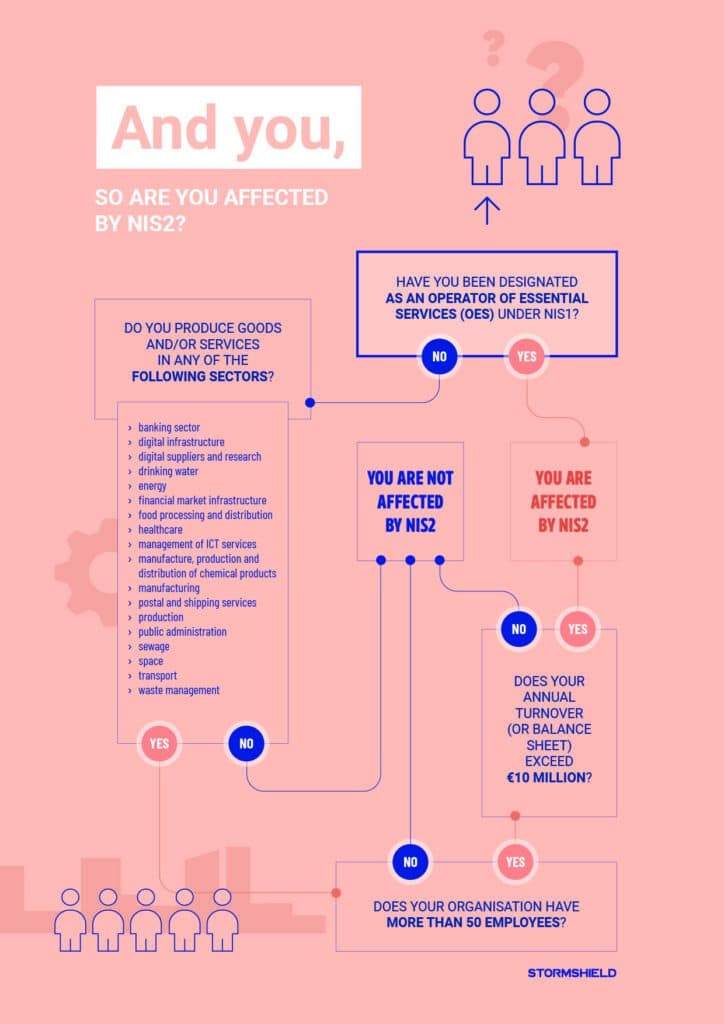
With the NIS2 directive, the European Union introduced essential entities (EE) and important entities (EI). These players provide an essential service, the interruption of which would have a significant impact on the functioning of the economy or society of one of the countries of the European Union. They therefore have sensitive and critical infrastructures that must be protected at all costs. But how do you know if you are covered by this European directive? This infographic provides an initial answer, based on four quick questions.
Compliance
The security measures of NIS2
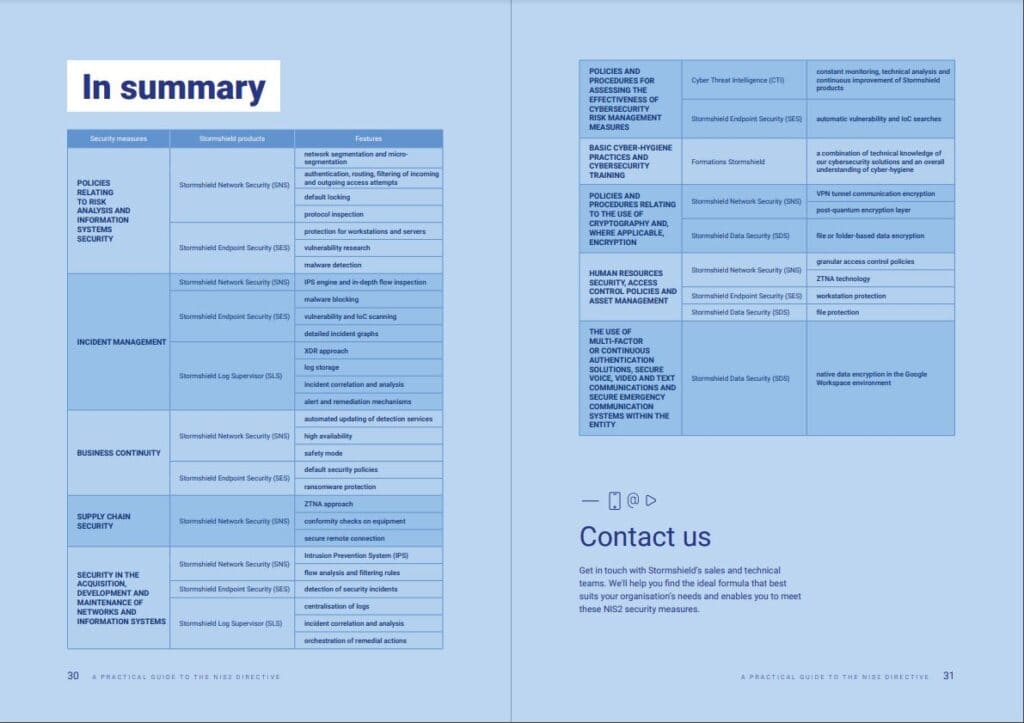
Before it is transposed into national law, the European NIS2 directive already sets out a series of 10 security measures. This information gives an initial impression of the direction that this cybersecurity standard is taking.
Encryption
A particular focus on data encryption
Article 21 of the NIS2 Directive emphasises the importance of data encryption, and security risk management measure No. 8 refers directly to this, as it mentions ‘policies and procedures relating to the use of cryptography and, where appropriate, encryption’. This clearly demonstrates the importance of relying on strong encryption algorithms.
Whitepaper
Download the Stormshield practical guide to the NIS2 directive
These two infographics are taken from a more comprehensive document on the NIS2 directive and the issue of compliance with Stormshield solutions. Because even now, it is possible to identify the first steps you need to take. This cybersecurity white paper is therefore intended as a practical guide for all organisations that will be affected by the NIS2 Directive in the coming months and years.
Why choose Stormshield for your NIS2 compliance
With Stormshield, you can rely on a recognised European provider to implement trusted cybersecurity solutions.
- Stormshield Network Security (SNS): SNS firewalls undergo regular certification by ANSSI, which attests both to the robustness of these products and to their reliability in meeting the NIS2 objectives for network protection.
- Stormshield Data Security (SDS) & Stormshield Encryption Platform (SEP): the Stormshield range of data encryption products is based on technology certified to the highest European standards, ensuring the protection of sensitive data throughout its lifecycle and meeting the NIS2 objectives for data protection.
Contact
Contact the Stormshield teams
NIS1 versus NIS2, ex-OES versus critical entities, NIS2 compliance, implementation of the directive: it’s not easy to make sense of it all. If you have any further requirements or queries regarding your company’s compliance with ENISA’s European standards, our teams of experts, sales representatives and pre-sales engineers are on hand to answer them and provide you with the best possible support for your sovereign cybersecurity project.
F.A.Q
Your questions about the NIS2 Directive
What is the NIS Directive?
Complementing the cybersecurity framework for operators of critical infrastructure, introduced by the French Military Programming Act (LPM) in 2013, the European Union adopted the Network and Information Security (NIS) Directive in 2016 and established the designation of Operators of Essential Services (OES), accompanied by a list of recommendations for their compliance.
What are the differences between NIS1 and NIS2?
The revision of the European NIS2 Directive involves an expansion of the scope of stakeholders, a shift in terminology (from essential service operators to essential entities and important entities), and a new binding dimension to the directive.
Which sectors are covered by the NIS2 Directive?
As specified in the Official Journal of the European Union, there are 18 sectors concerned, divided into critical and highly critical sectors.
There are 11 highly critical sectors:
- energy (electricity, heating and cooling networks, oil, gas, hydrogen),
- transport (air, rail, waterborne and road transport),
- banking,
- financial market infrastructure,
- health,
- drinking water,
- wastewater,
- digital infrastructure,
- ICT service management,
- public administration,
- space.
There are seven critical sectors:
- postal and courier services,
- waste management,
- manufacturing,
- production and distribution of chemicals,
- manufacturing,
- processing and distribution of foodstuffs,
- manufacturing (manufacture of medical devices, IT, electronic and optical products, electrical equipment, machinery and equipment, motor vehicles and other transport equipment),
- digital service providers and research.
To provide an even more detailed description, the European Directive sets out a list of entities corresponding to specific business activities. This list is not exhaustive: certain details remain to be defined in the context of national transposition, for example to include or exclude specific entities (following a national risk analysis or a national defence and security clause).
What are the obligations of essential and important entities?
Firstly, the obligation to report incidents enables a swift response and helps to contain the cyber threat. Whilst the directive specifies an initial notification of the incident within 24 hours, it allows for some flexibility in the context of national transposition, particularly regarding the timeframe for implementing security measures. At the same time, companies, subcontractors and local authorities will be required to undergo security audits in order to receive recommendations and thus meet stringent security standards.